
The Forbidden Island
How Albania learned to say no

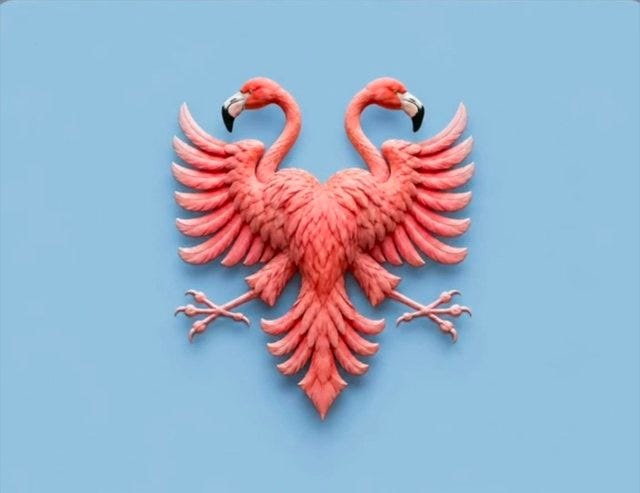
When I was a child in the 1980s, on the long sandy beach of Vlora, there was an island that was difficult to understand. Sazan sat just off the bay, close enough that on a clear day you felt you could swim to it, a green hump of land between the Adriatic and Ionian seas. I would point at it and ask the adults what it was, and the answers came back short. A military zone. Nothing for you there. This was perhaps my first encounter with a place that could be both completely visible and completely off limits. I did not have a word for it then, but the island was a piece of the regime set down in the sea: you could see it every day of your childhood and never, ever go.
What I could not have known, pointing from the sand, was almost everything. That Sazan had been a sealed garrison since before I was born, rumoured to hold a chemical-weapons store, that it had been a Soviet submarine base for a few years in the late 1950s until Enver Hoxha quarrelled with Moscow and the submarines left, that more than two thousand people had once lived on its five square kilometres with their own school and cinema and hospital, cut off for six months at a stretch and that the hillsides I was staring at were studded with something like three and a half thousand concrete bunkers, the mushroom domes the dictatorship poured across the whole country in the certainty that the world was coming to invade. The island was forbidden because it was a weapon. It stayed wild because it was forbidden. No one built a hotel on Sazan for the same reason no one picked the flowers: you would have been shot.
The island opened to visitors only in 2015, a day trip from Vlora, the bunkers turned into backdrops for selfies. What I never imagined was the turn that came next. Across 2024 and 2025, in a chain of decisions almost no one was shown, Sazan was promised away — strategic-investor status granted at the end of December 2024, the plans in the newspapers by the new year — tied to a company built around the family of the President of the United States.
The excavators in the lagoon
In the last days of May 2026, excavators moved into the wetland at Narta, on the coast just inland from Sazan, and began cutting roads into the sand. The land they were opening sits inside the Pishë Poro–Nartë Protected Landscape, within the wider Vjosa–Narta wetland complex, which conservation groups describe as sheltering more than two hundred bird species and over seventy threatened species, including flamingos, Dalmatian pelicans, loggerhead turtles and Mediterranean monk seals.. It lies at the mouth of the Vjosa, the river the same government had declared, barely three years earlier and to international applause, Europe’s first Wild River National Park. The machines arrived before the public had seen a complete permit file, environmental assessment or consultation record. They were preparing the ground for a luxury resort: as many as ten thousand rooms and villas across the lagoon and out onto Sazan itself, a marina, international-branded hospitality, and a project concept that media reports have linked to Aman and to the repurposing of Cold War tunnels and bunkers. The public face of the project is Jared Kushner, Donald Trump’s son-in-law, and his wife, Ivanka, who has described swimming ashore on Sazan from a friend’s boat and being “captivated.”
Albania, which agrees on almost nothing, did not stay quiet. Within days, several hundred gathered at the Zvërnec/Narta site; then thousands filled the streets of Tirana over successive nights, marching from Skanderbeg Square to the prime minister’s office. They carried inflatable flamingos. They held signs that said Albania is not for sale and I don’t want Albania like Dubai and, with a directness that needs no translation, Ivanka, go home. When masked private security guards dragged protesters away from the site at Narta while the state police stood and watched, the images travelled faster than any slogan. The protesters issued five demands, the first of which was the resignation of the government, and they did something protests rarely do: they refused the politicians outright. No party banners, no leaders on the platform; when anyone reached to plant a flag over the crowd, the crowd closed it down. Asnjë partiak, they said. No party men.
The prime minister, Edi Rama, in power for thirteen years and four elections, went on CNN and, in the conspiratorial register so much in fashion lately, called it a hybrid war. In the pro-government press villains multiplied by the day: Greek newspapers and buses with Athens plates, Islamic circles exporting antisemitism, the enemies of his son-in-law Kushner hunting for a needle in the Zvërnec haystack, even Russian agents in the crowd. Albania, he said, was under attack from enemies in the Mediterranean and from hundreds of thousands of fake accounts manufacturing a storm. Which enemies, he did not say; controlled by whom, he did not say. “There is absolutely no chance that the investment will stop as long as I am here.” To the protesters under his window he offered, with the contempt of a man who has won every fight, a negotiation: gather twenty of you, he said, and we’ll talk. They answered that there was nothing to discuss.
What the protest is actually about
It would be easy, and not quite wrong, to file this as an environmental protest, or as an anti-Trump protest, the global resistance washing up on a Balkan beach. Both readings are available and both are too small. Something larger is moving on that boulevard and the clearest account of it came not from a foreign correspondent but from an Albanian writer, Kristi Pinderi, who argued in the middle of the marches that this was the first time Albanians had taken to the streets to reject not merely a corrupt deal or a violent state or an opaque tender, but neoliberalism itself, the economic model sold to them since 1991 as the highest form of capitalism and the only road forward.
There is a fair objection to Pinderi’s word, and it is worth meeting head-on. Plenty of the people who marched would never call themselves enemies of the market. They do not want less investment; many want a great deal more of it. What they reject is narrower and more exact: a system in which the rules bend for whoever stands close enough to power to bend them, in which a protected coast can be reclassified, fenced and handed over before the public has seen a single document. Call it neoliberalism or call it kleptocracy — my uncle insists on the second word, that every faction here governs by capture and the labels are a distraction — and the lived sensation is the same. The market was supposed to reward the best idea and the hardest work. In Albania it rewards proximity. And running alongside that anger is something the cynical reading misses entirely: a plain, unembarrassed love of the place itself, of a coastline people grew up on and do not want to watch vanish behind a fence. The demand is not for stagnation. It is for transparency, and for a few things to be kept out of the auction altogether.
That word, neoliberalism, is still worth pausing on, because of where it is being said. For thirty years Albania was perhaps the most uncritically pro-Western country in Europe, and it had earned the right to be. We came out of the most hermetic dictatorship on the continent, a regime that broke with Moscow for being too soft and with Beijing for being too pragmatic, and when the walls finally fell the appetite for everything Western was total and slightly absurd. Above all we loved America, and we loved it for a reason with a name: Independence historically helped by Woodrow Wilson and, more recently, Kosovo. It was American power that stopped the killing in 1999 and American recognition that blessed Kosovo’s independence in 2008. And a people who does not forget who showed up. When George W. Bush became the first sitting US president to set foot in Albania, in 2007, the crowds in Fushë-Krujë mobbed him, the town later raised a statue to him, and Tirana renamed the street in front of its parliament George W. Bush Boulevard. To grow up in the Albanian diaspora was to find the worship a little ridiculous on its face and entirely understandable underneath: the rebound of a country told for forty-five years that the outside world was the enemy, and wanting now only to be let in.
So when I watch that country, that country, throwing inflatable flamingos at the son-in-law of an American president and shouting that the nation is not for sale, I feel something I did not expect to feel about Albanian politics, which is surprise. The place that adored the West without conditions is the place now naming the conditions out loud.
The country that said yes to everything
I was not quite twelve when we left, in the middle of the 1990s, for Italy, across the same Adriatic whose haze had framed the island. So I did not so much grow up in transition Albania as visit it, summer after summer, the way you notice a relative’s decline precisely because you are not there to watch it day by day. Each return, the coast had a little less of itself. A beach I had known was now behind a fence. A pine wood had become a car park. The edges of the lagoons filled with grey, rebar-haired concrete frames, the half-built houses of people who had gone abroad to pay for them and never quite finished.
It would be dishonest to tell only that half. The Albania I went back to was also, plainly, getting better. Roads appeared where there had been mud. Tirana, grey and frightened in my childhood, filled with cafés and colour and a noise that was not fear; a middle class that had never really existed began to take shape; the same coastline now being fenced was also bringing real money into towns that had known only emigration. Go almost anywhere in the country today and you will find a standard of living decidedly higher than the one I left behind. The problems are real and I will not soften them, but anyone who tells you Albania simply declined has not been paying attention. The transition gave with one hand. The argument now is about what it took with the other.
What it took, in the language the protesters are using, was the difference between democracy and the thing that arrived dressed as it. The philosopher Lea Ypi has written the clearest account of how the swap was made: the genuine, overwhelming desire for political freedom was bundled together with one particular economic prescription, the shock therapy of rapid privatisation and an open market with no floor beneath it, as though wanting to vote and wanting to sell off the state were the same wish. They were not. The freedom that arrived, Ypi writes, turned out to be freedom only for some. In 1996 and 1997 the whole experiment detonated: the pyramid savings schemes that much of the country had poured its money into collapsed, the state dissolved, the army’s depots were looted and Albania spent a year on the edge of civil war. I was there for that New Year’s Eve, trying to light a small artisanal firework while the neighbour stepped onto his balcony and emptied a Kalashnikov into the black sky, while boys my age threw grenades into the river for fun. I ran into the corridor and hid as the whole neighbourhood gleefully detonated the ammunition it had prised out of the state’s own depots. That is the founding trauma of Albanian capitalism and we have been told to keep waiting for its rewards ever since.
Pinderi puts the mechanism more bluntly than an economist would. Four times — in 1992, 1997, 2005 and 2013 — Albanians decisively elected the man each time presented to them as the right one and each time the right man did the same thing: more privatisation, less spent on hospitals and schools, less of a state to regulate any of it. When there were no more factories to sell, governments sold the assets of the army. When those ran out, they turned to nature, mostly the coast. And when the public’s own beaches and forests had been parcelled out, they began on citizens’ private plots, consolidating small holdings into lots large enough to hand, in Pinderi’s phrase, to the sheikh or the son-in-law of the moment. This, he writes, is what we have learned to call investment.
Underneath it lies the quietest theft of all, the one you only notice once it is complete: the disappearance of the commons. A child in Hoxha’s Albania owned nothing and was watched by everyone, but the water, the air, the forest, the river, the sea, the scrap of ground between the apartment blocks belonged in some rough way to all of us and were open to all of us. The transition did not pass those things to the people. It passed them to whoever could fence them and put nothing in place to guarantee the rest of us a way back in. You can do up your own flat as nicely as you like. It helps you little if there is no road outside it, and if there is a road, no park, and if there is a park, no clean water, and if there is water, no air worth breathing. A country can raise its average wage every year and still leave the median citizen one illness from ruin. That is not the capitalism anyone was promised in 1991.
The anatomy of a sale
To see how a protected coast becomes a private one, follow the paper. The paper is where the real drama hides.
It opens, as these stories do, with a quiet change in the law. In March 2024 parliament rewrote the statute on protected areas so that five-star resorts could be built in places that had been protected, until that morning, precisely so that they could not. Within weeks, Kushner’s Balkan plans were in the press. The timing was not a coincidence; it was a sequence. Brussels noticed: the European Commission called the amendment a “negative development,” and the Union’s own negotiating text went further the next year, demanding that Albania repeal the offending clauses and wind up the regime that hands foreign investors their “strategic” status. Hold that thought, because it is the hinge of the whole affair. The deal Rama defends as the future of Albania is, in writing, one of the things standing between Albania and the European membership he has promised the country by 2030.
Then the public record split in two, so that no single eye could hold all of it, making the project hard to follow. Sazan went through the front door, loud and official: strategic-investor status, a ten-year grant, €1.4 billion, forty-five hectares, a thousand promised jobs, the state quietly taking a stake of its own, the final contract parked for a future vote in parliament. The mainland at Zvërnec went through the side door, the planning agenda, where a “resort permit” in January 2025 matured into a “multifunctional complex with a marina” by March 2026 and then, in April, into permission to raise the fence and cut the roads whose excavators set off the protests. One half of the deal was a press release. The other half was a footnote. Together they made a fog, and the fog was the effect. Albania had, after all, signed the Aarhus Convention back in 1998, binding itself to let its citizens see the documents and share the decisions whenever the environment is at stake. At Zvërnec it behaved as though it never had.
Now follow the money, because this is where it turns strange. The face of the project is famous; stand behind the face and the light goes out. Reporters at BIRN pulled the company filings and found not an owner but a Russian doll of them: the operating firm held by another firm held by another, six in a chain, real control resting with two Qatar-based billionaires, the brothers Al-Khayyat, who built much of the Qatar World Cup. One link in the chain is a Dutch shell whose Albanian shareholders hold, with a tailor’s precision, exactly twenty-four per cent — one point below the line that would force their names into the public register of owners. After ten rounds of negotiation the company had still produced no business plan. It had produced, instead, a structure built so that you could not quite say whose coast this was becoming.
And then the detail I had to read twice. Sazan is still seeded with the dictatorship’s unexploded ordnance, live munitions in the ground sixty years on, and someone has to lift them before the villas can rise. In a decision of December 2025, that cost was moved off the investor’s books and onto the Ministry of Defence. Read it slowly. The Albanian taxpayer will pay to clear the dictatorship’s bombs out of the soil, so that the dictatorship’s fortress can be handed over swept and safe to a billionaire’s resort. The state pays for the water, the power, the sewage and now the mine-clearing; the developer pays no tax while it builds. Strip away the language of partnership and the shape is plain: the public carries the cost and the risk, the private collects the coast.
And the prosecutors? SPAK, the anti-corruption office the European Union built and funds, did open a file — into how the land changed hands and how its protected status was lifted. At one point it was reported to have frozen some two hundred million dollars tied to the purchase, then, within days, to have let it go. I say “reported” because the prosecutors have left almost no public trail and that silence is its own small chapter of the story.
Here the irony closes like a trap. Years ago the political scientist Blendi Kajsiu argued that Albania’s whole anti-corruption crusade — the one Brussels sponsored, the one SPAK now personifies — worked, in practice, to install the market rather than to discipline it. If every wrong is named “corruption,” the model itself never stands trial and privatisation gets to dress up as reform. Watch it operate: A protected coast is opened by a change in the law, handed through a fog of shell companies to a president’s family, cleared of mines at public expense — and the institution built to stop exactly this manages only to freeze the money and, days later, to give it back.
The island, read as a country
Step back from the filings and look once more at the island, because Sazan carries the argument more honestly than any document.
For half a century the most isolated regime in Europe aimed that island at the outside world like a loaded gun, and in doing so, without meaning to, kept it perfect: the coves, cliffs, military ruins, clear water and surrounding marine habitats, the silence no developer had yet broken. The very wildness that now prices Sazan at a billion euros is the inheritance of the paranoia that made it forbidden. And the wheel has turned all the way round. The coast Hoxha sealed against the capitalist world is to be opened to its purest living emblem; the bunkers he poured against the West are to be redecorated as suites for it. Ismail Kadare, who spent a lifetime writing the inside of the dictatorship in metaphor because he could not write it plainly, died in 2024, just before the excavators came. The conscience of the closed country went out more or less as the coast of the open one was put up for sale.
That is the arc, written on five square kilometres of rock: a nation that defined itself first by shutting the world out, then by letting it in without a single condition, and now, for the first time, trying to fix a price below which it will not go.
A country built for people who have left
Ask the question the brochure never answers. Who is this coast for?
Not for Albanians, most obviously because there are fewer of them every year. The country has fallen from around 3.2 million people at the start of the 1990s to the 2.4 million of the last census — and many demographers suspect even that is generous, the figure padded, they argue, to soften the political blow. Albania has the highest youth emigration in Europe; in a single recent year some eighteen thousand people between fifteen and twenty-nine simply left. I was an early instance of that emptying, a boy with a suitcase on the ferry to Italy.
But look closely at who actually filled the boulevard and the easy story about the fleeing young breaks down. The crowd did not skew to teenagers. It skewed to their older brothers and their parents, people in their thirties and forties — the generation that came of age with no name on the ballot but Rama or Berisha, that watched its own parents lose inherited land to whoever could win the court case, that has spent two decades working full days for a life it still cannot quite assemble. The journalist Andi Bushati, writing from the middle of the marches, put it better than the foreign coverage did: one by one, every valve that used to let the pressure escape had been screwed shut. When abuse grew too large, the opposition used to raise its voice; this time the opposition backed the deal. When things went truly wrong, an American or a European voice used to warn that this was not the way; this time the man tipped to be the next US ambassador let it be known that Washington would not speak against the interests of its president’s family. With every exit sealed, the fence at Narta became the ceiling of the possible and the people who had nowhere left to push, pushed into the street. This is, at bottom, a protest about dignity.
And what is on the block is not nothing. Albania is, by Mediterranean standards, fabulously rich in the one thing the region is running short of: water. It holds several times the renewable freshwater per person that water-stressed Italy does and that wealth is why the country stays green where so much of the southern Mediterranean is going brown, why the Vjosa runs wild, why the lagoons fill with birds. That abundance is the real asset on the table. The resort takes a thing that belonged loosely to everyone and turns it into what one Albanian scholar called privatised scenery for the very rich — the water that made the place worth living in, reduced to the view from a villa. And the protest has gone where the people went: it is being held now in Milan, Florence, London, New York and Toronto, a diaspora defending a coast it no longer lives on, against buyers who will.
Neither Rama nor Berisha
Which returns us to the most telling thing in the square, the thing that ought to frighten the government and the opposition in equal measure.
The crowd would not be claimed and the refusal was not a pose. Sali Berisha, the eternal alternative, did not even try to lead it. He came out for the deal. The land is private, he said; we support foreign investment; a government of mine would have done the same; those who weep over Sazan are hypocrites. The man who has spent thirty years as the other option lined up behind the sale — in part, it is widely understood, because he is barred from the United States as “persona non grata” for corruption and hopes a Trump administration will lift the ban. One local paper summed the week up in a headline that needs no gloss: at Zvërnec, the opposition decided not to oppose.
Fatos Lubonja, who survived seventeen years in Hoxha’s prisons and has spent the decades since as close to a national conscience as Albania has, has been making the underlying point for years: the real story is the fusion of state and oligarchy behind a rotating façade. What is new is that the street has caught up with him and that it arrived there not through a party or a programme but through the defence of a forest, a lagoon, an island.
What do you do when the men who sold you the West and the men who promised to clean it up turn out to be backing the same buyer? You stop asking them and you start from the ground under your feet. That is what makes this movement legible across the region, in the same season that Serbia’s students have walked out on their own captured politics: a generation that has given up choosing the right man and begun, instead, to guard the commons itself. It is a smaller thing than a revolution and a larger thing than an election.
What the island knows
The placards say Albania is not for sale and the honest reply is that Albania has been selling for thirty years, in instalments, while most of us were abroad earning the money to finish the houses we left half-built. That is true, and it is the whole reason this matters. A country that loved the market without conditions, that put an American president’s name on its grandest boulevard, has finally found one thing it will not trade — and learned in the refusing what its freedom is actually for. Pinderi said it more plainly than any manifesto: freedom was never the licence to swallow everything in reach; it is a society’s power to secure the dignity and the future of its own people. That is the sentence the flamingos are carrying.
I keep returning to the boy on the sand at Vlora, pointing at the island he could see and never reach, asking the question no adult would answer. The question was always the right one. Why is that place closed to us? For half a century the answer was: because it is a weapon and you would be shot for asking. Lately the answer was about to become: because it has been sold and you were never meant to afford it. What the crowd on the boulevard is writing, with its plastic birds and its scorn for every party, is a third answer, and it is the one I never expected my country to reach while I was alive to see it. The island is not a weapon now and it is not a private beach. It is ours. We are, at last, awake enough to say so.
I lived and worked in Tirana as a very young woman (mid twenties to 30) from 1996 to 99. I loved it so much and still go a couple of times a year. More and more lately since Ryanair have put on direct flights from Dublin. While I was there I married a man from the sheshi skendebeu end of Rr Durres. The residents of the old pallati he grew up in (which he has inherited) have had so many developers banging on their doors promising a fancy new apartment if they just let them knock it down and build another monstrosity there (it’s bang next to the Eyes of Tirana). Anyway we have all resisted. Didn’t even have to phone each other. A universal Jo. My now adult son is there now for a month and he and his Irish Filipino girlfriend marched last night and will again tonight before heading to Himare for a fortnight, all the while trying to figure out a way to stay there permanently in the long term. There’s definitely a massive shift happening. I knew Edi Rama 30 years ago, quite well really, and he would have been at the protests in those days. I can’t get over his behaviour now. Is it partly performative I wonder. Talk about selling your soul. I am glad Fatos Lubonja is still out there fighting the good fight. Such a prescient mind. Anyway. I loved your piece and agree with every word.